
- April 26, 2024
- Posted by: Gaurav
- Categories: Blockchain, Blogs
A Directed Acyclic Graph (DAG) is a directed graph that does not contain any cycles.
The Directed Acyclic Graph consists of vertices and edges, in which edges indicate the directed path from one vertex to another without the cycle formation. This implies that the graph is “directed” (edges have been defined on directions) and “acyclic” (there are no feedback loops).
Directed: In a DAG, each edge has a direction, indicating a one-way relationship. This direction goes from one vertex (node) to another and is often represented by an arrow in graphical representations. The direction of an edge signifies a dependency or a flow from one node to another. This is particularly important in applications where the sequence or hierarchy matters, such as task scheduling, data processing pipelines, and representing state transitions.
Acyclic: Being acyclic means that if you start from any node and follow the directed edges, you will never encounter a cycle or a loop that brings you back to the starting node. This absence of cycles is fundamental to the definition of a DAG. The acyclic characteristic ensures that there is a well-defined order or hierarchy among the nodes. For instance, in a DAG, it’s possible to perform topological sorting, which arranges the nodes in a linear order, respecting the directional dependencies between them.
Graph: A graph is a set of nodes (or vertices) that are connected by edges. In the context of DAGs, these nodes can represent various entities depending on the application, like transactions, tasks, data elements, etc.
How Do DAGs Work?
In DAGs, each node can have multiple parent lines on the roots, simultaneously guaranteeing of transactions. This feature to a large extent increase the scope of DAGs while helping them to reduce network congestion. This technique usually utilizes PoS (Proof-of-Stake) consensus processes to save energy.

From large corporations to innovative startups, the adoption of DAG technology is creating new paradigms for handling data and processes.
Oracle International Corp, DreamWorks Animation LLC, SAS Institute Inc, and Microsoft Technology Licensing LLC are among the leading corporations that have recognized the potential of DAGs to enhance their operations. These organizations have applied DAGs in diverse ways:
Oracle International Corp: Enhancing Cloud Infrastructure
Patent: US11842221B2
Published: 12 December 2023
The patent has identified numerous problems in the delivery of services across cloud infrastructures, especially as operations become larger. Some of these challenges include:
- The setting and deployment of services depends heavily on manual activities, which are not only prone to error because of the increasing number of service teams and deployment regions.
- Limitations in scaling up infrastructure: Traditional deployment approaches are becoming less efficient at handling increased numbers of service teams and geographical diversity resulting in more expenses on operations and complexities.
- Complex Dependency Management: It is often difficult to effectively manage dependencies between different tasks for deployment and their execution targets thereby leading to delays in deployments or possible failures.
This patent suggests a sophisticated method based on Directed Acyclic Graphs (DAGs) that can help overcome these challenges:
- DAG Automation: The process involves building two types of DAGs; one to manage dependencies between various deployment tasks, while another one handles dependencies among different service deployments across differing execution targets.
- Deployment with structure minimizes errors: Using DAGs, the system automates the deployment process reducing human intervention and hence limiting its chances of making mistakes during deployments.
Apart from minimizing manual intervention thus reducing errors, it scales well as complexity increases with deployment growingly dynamic. The system adapts dynamically to real-time changes ensuring that deployments are performed as optimally as possible.

DreamWorks Animation LLC: Improving Realism in 3D Animation
Patent: US10460498B2
Published: 29 October 2019
Challenges are identified in the patent, especially as regards handling interactions and constraints between virtual 3D objects within a virtual space.
Some of the issues include:
Complex Finger Dependency: Managing dependency relationships among virtual objects like ensuring that moving or transforming one object correctly affects other relevant objects.
Manual Manipulation: Animators have to do manual adjustment on each frame to maintain realistic interactions among the materials which is time-consuming and error-prone.
Realism in Animation: For such animations whose objects are interlinked, utmost accuracy should be achieved to ensure that they move as needed. This is however difficult with traditional animation tools that lack support for advanced constraint management.
A system for enhancing the control of constraints between virtual 3D objects using directed acyclic graphs (DAGs) is suggested by this patent. It entails:
DAG-Based Constraint Management: This allows clear and effective control of dependencies by employing DAGs to represent and handle constraints existing between different virtual 3D objects.
Automated Constraint Evaluation: Evaluating automatically those restrictions within the DAGs defines result in changing child’s properties depending on their parents’ developments. These adjustments minimize manual manipulation during animations therefore reducing errors made in such process.
Enhanced Realism and Efficiency: The animation becomes more efficient while producing more realistic animations through DAG-based constraint management because all movements and dependencies remain consistent throughout an entire output.

SAS Institute Inc: Streamlining Data and Task Management
Patent: US10331495B2
Published: 25 June 2019
The patent addresses issues in distributed development environments where managing large data sets and task routines is challenging. Key problems include difficulty in tracking dependencies between tasks, lack of visibility for oversight and error checking, and inadequate support for collaboration and reusability of pooled data and analysis routines.
The solution involves generating visualizations of Directed Acyclic Graphs (DAGs) from task routines to enhance management and oversight. This system parses task routines to identify dependencies and visually represents these relationships in DAGs. It provides a user interface that allows users to interact with the DAG, edit dependencies, and create new DAGs for improved collaboration and data reusability.

Microsoft Technology Licensing LLC: Optimizing Machine Learning
Patent: US10832163B2
Application Granted: 10 November 2020
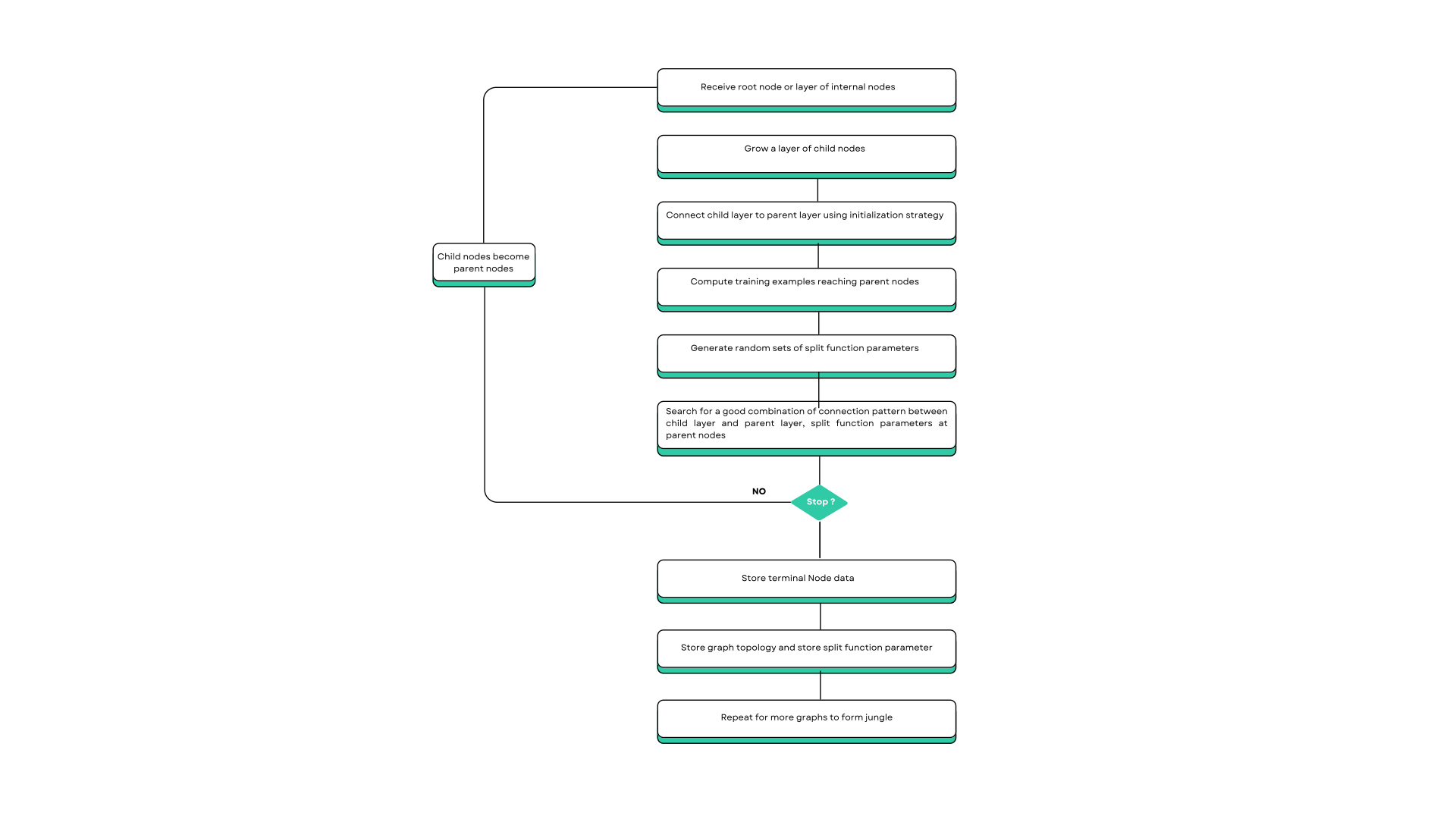
The patent identified challenges with existing machine learning systems, particularly those used for gesture recognition and other complex recognition tasks, which require extensive memory for training and operation. This makes them impractical for deployment on resource-constrained devices such as smartphones and embedded systems. The traditional training of decision forests, often essential for these tasks, is not only resource-intensive but also time-consuming, resulting in models that are too large and thus unsuitable for limited-memory devices. This constrains their accuracy and the ability to generalize well across different scenarios.
To address these challenges, the patent proposes the use of directed acyclic graphs (DAGs) to facilitate memory-efficient machine learning. By training multiple DAGs, the solution optimizes the training process to consider both node connection patterns and split function parameters effectively. This approach enhances the scalability of training on resource-limited platforms by enabling the growth of DAG layers with strategic initialization and local search processes to refine connections and parameters. Consequently, the resulting models are more compact, requiring less memory while retaining or improving accuracy and generalization capabilities, making them suitable for deployment on devices with limited resources.
Taraxa: A Startup Transforming Informal Transaction Management
Taraxa was founded in 2018, that leverages Directed Acyclic Graph (DAG) technology to specifically address the issue of tracking informal transactions, which are often verbal or ad hoc, to bring more reliability and efficiency to operational agreements. The aim is to create a digital trail for these informal agreements, reducing the likelihood of disputes and increasing overall transparency and trust in business processes.
Utilizing DAG, Taraxa provides a scalable and efficient infrastructure for recording transactions. DAG allows for faster transaction throughput compared to traditional blockchain structures, making it well-suited for Taraxa’s goal of capturing high volumes of informal transaction data.
Taraxa’s technology is particularly useful for businesses that rely heavily on informal agreements, providing a more robust framework for managing these agreements.
Conclusion: The Versatility of DAGs Across Industries
Directed Acyclic Graphs are becoming crucial for everything from improving cloud deployments to refining machine learning processes and animating virtual environments. The widespread adoption of DAG technology by well-established companies and creative startups such as Taraxa demonstrates its capacity to transform a multitude of industries. DAGs offer vital answers for difficult problems, guaranteeing scalability, dependability, and effectiveness across the digital environment.